Showing posts with label Brochure. Show all posts

Monday, 30 January 2012

Yamaha Brochure: YZ TT IT TY

Yamaha Brochure from c1983:
YZ490    YZ250    YZ125    YZ80
TT600    TT350/250    TT225    IT200
TY250    TY125


Enlarged view of the Yamaha TY125
Enlarged View of the IT200


Sunday, 8 January 2012

TY175: Brakes and Forks Update

Here's a longer update on activity over the recent break:
Front Brake:
I touched up the NOS (New Old Stock) brake plate with Humbrol silver modelling paint, rather than stripping and refinishing it. I think it came out OK.
As this brake plate came with no speedo internals, I bought the worm gear parts from CMSNL (see link at top of page), and used the drive parts that engage with the wheel from my old plate.
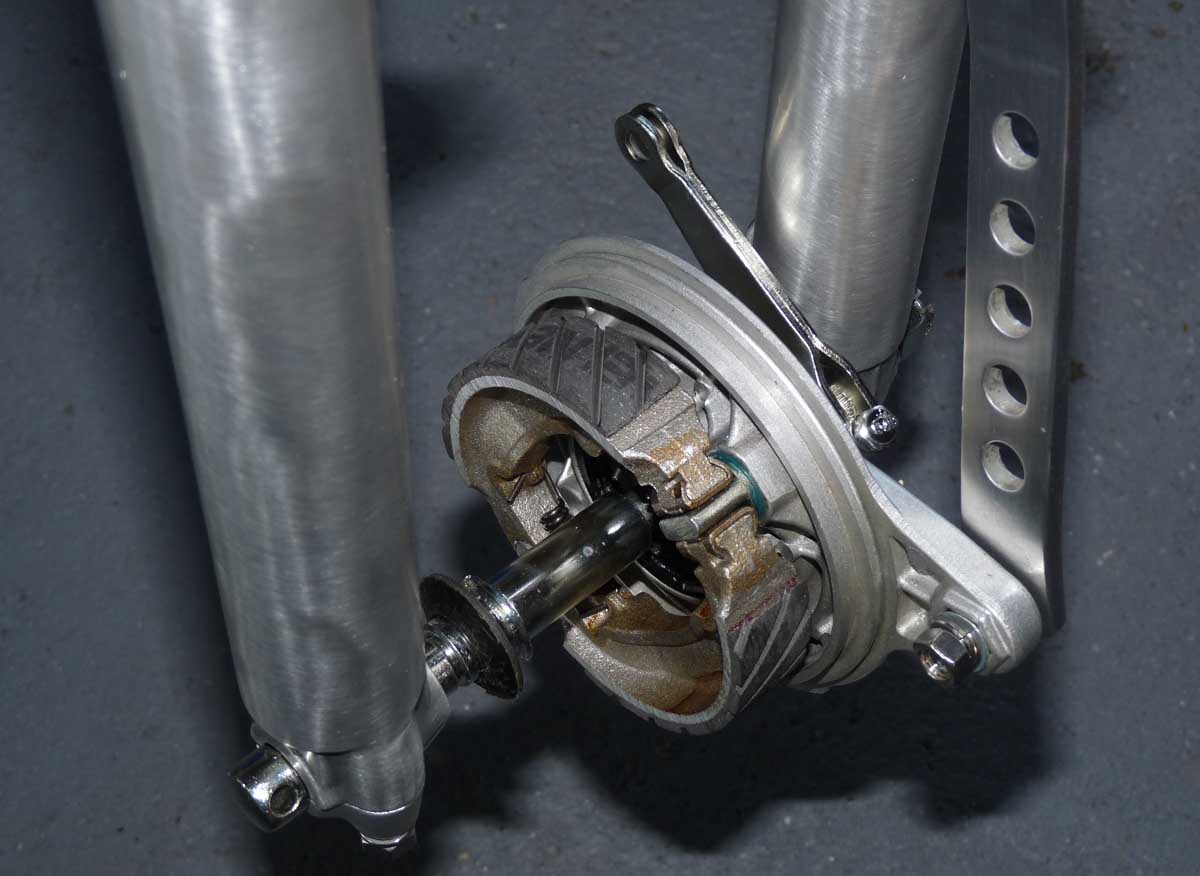
And adding new brake shoes, and the re-zinc'ed arm and cam, etc, I ended up with this:

I polished the alloy torque arm and along with the re-zinc'ed spindle, etc, I loosely installed the brake plate as below.
Forks:
You'll see here, that the forks are in. That's another job carried out. I cleaneed up (but not highly polished) the fork bottoms using scotchbrite pads in an electric drill. I've left the bottoms as bare ally, I'll not paint them. As you can see, they may still need a little polishing tweak just to 'average out' the scotchbrite marks. But, following earlier work on the yolks, I found the finish naturally mellows over time to a more even look, so hopefully, the legs will settle down too.
I installed new taper head bearings, and using re-zinc'ed original bolts for all except the handle bar clamps which are NOS Yamaha bolts, I re-fitted the yorks.

The forks are supposed to extend out of the top yolk by 20mm or so. I found NOS cable guides (one on each fork) from an eBay ad in Australia. My reference photos from Yamaha brochures seem to say to keep the left hand cable guide (RHS in image below) down as low as possible. NOTE: I've just realised that both guides should be on the same side as the lower guide (see ref images below), ie, both should be on LHS of the bike! I'll change that later! Although my parts books show the top guide on RHS.
Extracts from my ref images:

Rear Brakes:
Again, I touched up the NOS rear brake plate with Humbrol paint, rather than refinishing it.
Then added in the new pads, and re-zinc'ed original arm and cam, etc

And along with the polished torque arm, loosely inserted the brake along with re-zinc'ed spindle, spacers, adjusters, etc.

That pretty much completes the xmas break work on the bike. All coming along nicely. The sharp eyed will have noticed the tank installed at one point. This is my unfinished tank, and installed just to check if the forks cleared the tank on full lock. They didn't on left hand lock by less than a mm. I wish I'd have checked that before I had the frame painted, as I could have built some weld up on the stop. So, I'll just stick a small rubber pad on that stop (or more probably, both stops to keep things even) just to protect the tank once it's painted.

Sunday, 18 December 2011

NVT Poster Brochure

Here's a scan of both sides of an A2 (A4 folded twice) size fold out brochure for the NVT range in late '70's.


Ramblers —something a little different on the street/trail scene. Take another look at the Rambler picture and maybe you will see what we mean. You have probably already noticed the front disc brake but what about the cantilever rear suspension ? Or the rubber headlight? And who else supplies a chrome luggage grid within the basic price of the bike?

NVT took along hard look at the street/trail market before we embarked on our Rambler project. It is a young man’s market - these single cylinder dual purpose devices - but the buyers know their machines through and through ; all in all they’re a pretty discerning bunch. Not all of them ride on the rough but they like to know the bike will do it, if required. They demand looks and performance for town riding plus the specification of a twin cylinder sports machine for that trip into the country. So our brief was to provide all the obvious qualities that the British Companies do best. Things like a frame that, from the very first weld, is designed to handle with a capital ’H'!

Lighter too, and more rigid than the opposition. Next came the general geometry. We chose a compact 52.5" wheelbase, dialled in plenty of suspension movement, and arranged everything else to give a riding position that felt right, for everyone - at least, all those in the 5’ 4" to 5' 10" mould! Oh yes, some of our test riding was done with a slip of a girl on the back, so no worries there...

NVT's policy on outside suppliers is to go to the industry leader in each speciality. For the Rambler we therefore chose engines from the world's most successful manufacturer of off-road motorcycles. We simply fit these engines and forget about them, secure in the knowledge that they are the most proven
product available.

The same policy applies to our forks and brakes. Famous makers both, producing their well-known components especially for us, to our dimensions.

Finally, as you can see, the Rambler is a very appealing marriage of all the best parts one could possibly imagine. A handsome, rugged bike indeed. But don't just take our word for it. Check one out at your NVT Dealer today.

Here's a close up of the naked frame shown on this brochure:
 

TY175: Brochure

Here's a scan of a TY175 single sheet (double sided) brochure / leaflet. Undated.


Champion In The Power Game

Every element that provides fun and pleasure in motorcycle sport has been refined into the TYl75. All Yamaha’s exclusive skills have gone into producing this lightweight that packs a championship punch whenever its front wheel crosses the "Section Begins" card. Club riders and those of international calibre, have found that the TYl75 with its lightweight low-down torque and instant take-off from the bottom of the speed range, provides a trials motorcycle capable of being used on every type of going from the tight, artificial sections of forest land to the natural, rock climbs of mountain country. This is the machine to provide the ultimate satisfaction for the rider when looking back at the section having
recorded a perfect "clean".

Engine
A total design commitment to trials riding has given the tough 2-stroke, single-cylinder engine the ability to allow the rider to rely implicitly on its low-speed power and its instant response to his demands in the tightest of sections.
Yamaha's exclusive Autolube lubrication system provides the precise amount of oil needed by all working parts of the engine, enabling maximum use to be made from the charge of fresh petrol being drawn-in for every firing stroke.
Reed valve Torque Induction aids the engine`s instant response characteristics. Throughout the engine, quality lightweight materials have been utilized to the full to ensure the best possible power-to-weight ratio.

Transmission
Matching the power output of this lightweight trials machine perfectly is the TYl75 6-speed, wide ratio gear box. Every gear has been specifically selected for the use to which it will be put, either in competition on the sections themselves, or maintaining tight schedules on road or trail between the sections.

Frame and Forks
The trials market demands the toughest frame with the lightest possible weight. Yamaha have incorporated a double-cradle frame of high tensile steel in the TYl75. The engine is tidily mounted at the best possible point to achieve optimum balance. The front forks are guaranteed as the best in the l75 cm3 trials world. They have exceptionally long (160-mm) travel, and considerable thought has been given to making them strong enough to resist the inevitable harsh treatment which they will receive, while helping to provide the rider with one of the leading trials machines in the world.

Rear Shock Absorbers
Superbly responsive hydraulic rear shock absorbers have been tuned for trials work. Readily adjustable to 5 different settings, the shock absorbers are more than adequate for every known aspect of trials-going.

Brakes
Trials riding tackles dust, water, mud and grit, but Yamaha engineers have developed the special labyrinth seal, double-ridge brake plates which prevent any foreign matter from entering the brake drum. Smooth and positive control of braking is thus guaranteed throughout the competition life of the machine.

Special Features
Yamaha`s trials machines have many special features developed by the world`s top riders and adapted on the competition machine production lines in Japan.
Check out the well protected street legal speedometer behind the left-hand fork leg. The entire ignition system has been designed to guarantee a large efficient spark at ultra-low speeds and the crankshaft mounted magneto aids the overall flywheel effect.
A rear chain tensioner automatically absorbs any slack in the chain and so prolongs chain-life as well as aiding positive rider-control at all the infinitely variable speeds which are called for from every
trials machine.
The whole underside of the frame and engine are protected by a rugged light-aluminium "bash plate".  The moulded aluminium plate absorbs all shock contact and on really difficult terrain. prevents the
machine from sinking into deep mud.
A silencing system designed to protect the environment and to maintain perfect peace during countryside use is a natural Yamaha feature. because, as far as trials are concerned, "less sound means more ground".

SPECIFICATIONS
ENGINE
Type                              2-stroke. Torque lnduction. Single
Displacement                 171 cm3
Bore & Stroke                66 x 50 mm
Compression ratio          5.8 : 1
Lubrication system         Autolube
Starting system             Primary kick starter
Primary transmission     Gear
Final transmission         Chain
Gearbox                       6-speed
Carburettor                   VM22SS
Clutch                          Multi-plate, wet
Battery                         6 V, 4 AH
Ignition type                  Magneto. CB/CoiI

DIMENSIONS
Overall length                1.955 mm
Overall width                 835 mm
Overall height                1,100mm
Seat height                   750 mm
Wheelbase                   1,265 mm
Weight (net)                  81 kg
Fuel tank capacity         4.5 lit.
Oil tank capacity           0.3 lit.
Tires     Front                2.75-21 - 4PR
            Rear                 4.00-18 - 4PR
Brakes Front                 Drum
            Rear                 Drum

°Specifications subject to change without notice.


BSA Tracker US Collector Card 1995

Here's a scan of a 1995 collector card printed in USA in 1995.


BSA
125 Tracker MTX - 1980                                     The end ofthe road

In the early 1970s, the Norton-Villiers-Triumph group (NVT) ran into some serious financial problems. Thus its chairman, Dennis Poore, decided to launch a sporty ultra-lightweight to complete his range. That machine had to be cheap to run, as well as fun to ride, in order to attract young riders to the NVT line and later persuade them to buy its larger models.

End of the State Aid
The overall concept was entrusted to Bob Trigg, one of the creators of the Norton Commando 750 and 850. The prototype made its debut at a press conference in London in July 1975. But that was the month that Britain’s socialist government refused to provide any further funding for NVT, which had already received $24 million in state aid.

Two World Firsts
That first Tracker, powered by a 125 Suzuki single, received a lukewarm welcome from the British press. It was, however, very modem, with a double-cradle frame in small-diameter tubing and monoshock rear suspension. Above all, it had two world firsts for a trail bike, thanks to the imagination of Bob Trigg. The saddle overlapped the gas tank (an idea taken from motocross) and there was a front disc brake (made in Italy, like the forks). This model was never produced by NVT, which ceased production shortly afterwards. The name BSA and the rights relating to the Tracker were acquired by a new company (founded by Bill Colquohon and Bertie Goodman, former director of Velocette), which produced nearly 2000 Trackers powered by Yamaha engines.

SPECIFICATIONS
Engine: 123cc (56x50mm) air-cooled Yamaha single-cylinder; flywheel magneto Power Rating: 15 hp
Valves: two-stroke
Fuel System: carburettor
Transmission: 5-speed, chain final drive
Suspension: telescopic forks (front); monoshock (rear)
Brakes: drum or disc (front); drum (rear)
Wheels: 21 inch (front); 18 inch (rear)
Weight: 220 lb
Maximum Speed: 65 mph

Built by a company that acquired the name BSA when NVT went into liquidation, the little Tracker 125 was the first trail hike to offer a disc brake: Its engine was supplied by Yamaha.

Monday, 5 December 2011

BSA Brochure on eBay

See this eBay ad, for a copy of the brochure outlined below. Ad has a Buy it Now price of £13.99.

BSA Brochure

Here's pages 5 and 6 of the BSA Brochure "The New Line Up From BSA". This brochure is undated, but published by BSA Company Ltd. Bannerley Road, Birmingham.


Now supplied with the latest six-speed engines the BSA I25CC and 175cc street / trail motorcycles are designed to combine the performance for road riding with the cross country ability to take on the rough.
The rear monoshock is so positioned in the cantilevered Tracker frame to maximise clearance between the hi-level guard and the rear wheel.
Standard specification includes long foam rubber dual seat, flexibly mounted direction indicators and headlight, extra length gearchange, drum brakes, oil level warning light all wrapped up in a dry weight of only 210 lbs.
 
DATA
Engine Type

Capacity
Bore and stroke
Comp ratio
Fuel
Lubrication

Transmission
Gear box /rear
wheel sprocket
Rear chain

Electrical
Ignition type
Battery
Headlamp
Tail / Stop Lamp

Tyres
Front
Rear


Brakes
Front
Rear

Capacities
Fuel tank
Oil tank

Dimensions
Dry weight
Overall length
Overall width
Overall height
Wheel base
Seat height
Ground clearance
Front fork travel
Rear wheel travel

Colour Choice

125/6
Air cooled 2 str
torque induction
I23cc
56/ 50mm
7.2 : 1
2 star
Autolube

Six-speed
15T/49T

1/2" x 5/16"


Flywheel magneto
6v 4 amp-hour
25/25watt
5/21 watt


2.75" x 2I"
3.50" x 18"
Trials type


16omm drum
14omm drum


1.0 gallons
1 .7 pints


210 lbs (94kg)
78.7" (2,000mm)
35" (899mm)
45.1" (1,145mm)
52.5" (1,320mm)
29.5" (750mm)
9.5" (240mm)
5.1" (I30mm)
4·9" (115mm)

Red, Blue,
White
175/6
Air cooled 2 str
torque induction
171cc
66/ 50mm
6.8 : 1
2 star
Autolube

Six-speed
15T/49T

1/2" x 5/16"


C.D.I.
6v 4 amp-hour
25/25watt
5/21 watt


2.75" x 21"
3.50" x 18"
Trials type


16omm drum
14omm drum


1.2 gallons
1.7 pints


210 lbs (94kg)
78.7" (2,000mm)
35" (899mm)
45.1" (1,145mm)
52.5" (1,320mm)
29.5" (750mm)
9.5" (240mm)
5.1" (I30mm)
4·9" (115mm)

Red, Blue,
White

Friday, 2 December 2011

TY175c Brochure Found on Web


Features:

Torque Induction engine The ail-new TY175C utilizes a single 2-stroke  aluminium engine with Torque Induction to increase the intake efficiency and yield more available torque over the lower and middle speed ranges. This outstanding performance is attained through the use of the transfer ports in the cylinder well. the addition of a seventh port which compresses a small quantity of fresh fuel on the intake stroke to be used for completely purging the combustion chamber of burned gases and a 4 petal reed-value assembly which supplies fuel to the engine on demand.

Autolube

YAMAHA developed the Autolube system which automatically supplies oil from a separate tankto be mixed with the gasoline. This is accomplished by precisely and continuously monitoring the engine speed and throttle opening so that only the exact amount of oil for optimum engine performance will be added. This system was developed in order to end the messy need for manually mixing the gasoline and oil, and as an extra benefit engine life is greatly Lengthened because the engine is always operating at optimum efficiency.

Transmission

Utilizing a 6-speed transmission the TY175C is ready to encounter the most varied trials section. The lower gears are designed for really slow going with smooth pulling power and a comfortable overlap between gears so that the power flow will be continuous. The higher range of gears allows the machine to be easily ridden on the roads In between the sections without straining the engine. Also, all gears have been precision constructed using specially-hardened tool steel for maximum durability and minimum back-lash when the machine is suddenly accelerated.

Flywheel and magneto mass

For the most part on trials sections, the Operating speed of a trials machine is very slow, and slow walking speeds are not uncommon. Generally, sow—speed operation is hampered by the pulsing forces of the piston which is operating just above its stall speed. but with the TY‘l75C. this problem has been eliminated with the use of a heavier mass flywheel and magneto. The inertial force of the rotating mass compensates for engine pulsing and yields a smooth performance without appreciably decreasing throttle response.


Carburettor quick change lever
For optimum low-speed high-torque operation through a trials section. the engine should be operated with a leaner fuel mixture. however, to obtain the best performance at higher speeds, such as on the roads in between the Sections, a normal-rich mixture is recommended. To eliminate time consuming, troublesome adjustments, the TY175C is equipped with a quick-change lever on the carburettor so that. with a simple flick of the finger the fuel mixture can be quickly changed for either section or road riding.


Frame

In order to assure that the TY175C will be able to withstand the severe treatment encountered on the roughest section. the frame design is a double-cradle type. This frame. with its high tensile-strength, tubular-steel construction, is based on the frames of the famous YAMAHA Motocross and Road Racer machines which have been consistent championship winners on leading tracks throughout the world. The double-cradle frame has become well-known among experienced motorcycle riders as e frame which can withstand the stresses, strains and shocks of competition riding and come out on top.


Front forks

The new TYi75C is equipped with hydraulically-damped, inner-spring front forks. These from forks have been selected after studying the data accumulated from some of the most formidable race tracks around the world in order to assure that the TY175C has forks with lasting performance and durability. Among the criteria searched for are those which offer machine stability without impairing manoeuvrability and as a result, the TY175C is able to cushion larger road shocks and maintain e more uniform performance attitude.


Chain tensioner

When riding through a trials section, precise control of the throttle and brakes are essential to prevent footing and the machine should be able to respond quickly and smoothly. In order to prevent the chain from back-lashing when suddenly accelerating, a spring-loaded chain tensioner is attached to the rear swing-arm. This tensioner maintains a constant pressure on the chain at all times to remove any slack which may occur, and in this way eliminates the cause of back-lashing.


Brakes

The TY175C has been designed from the ground up to be a top contender at trials events. In obtaining this ideal design, all types of terrain must be considered, therefore, the brakes have a special labyrinth seal that prevents water and dust from entering the drum and affecting the brake performance. Also the brakes have a large heat dissipating capability to assure that the brakes will not fade even under repeated hard use.


Yamaha DT / TY / XT Brochure

Here's a higher res image of the TY page from the brochure below.
And this is the text from the image:


Yamaha TY Series. . . With the Balance and Performance to Win Every Trials Event
Yamaha’s great new Trials models, the TY125 and TY250, are the result of Yamaha’s engineering skills as well as all of the experience and knowledge of one of the world’s top Trials riders, Mick Andrews. Every engineering feature and styling point has won his critical approval after severe tests. Lightweight and highly manoeuvrable, and with exceptional balance capabilities, these machines will meet and exceed the requirements of even the most demanding Trials rider. Yamaha has with these machines once again taken the leadership in motorcycling technology, combined it with unexcelled experience, and shown the way to the champion’s circle.

Engine
The Yamaha Trials series models are powered by engines especially developed for this gruelling test of man and his machine. Single- cylinder, 2-stroke design - a technology where Yamaha excels with scientifically determined piston design painstakingly matched to induction and exhaust ports. Low-speed power and instant response are superb to meet the demands of even the toughest sections. And, of course, Yamaha’s exclusive Autolube lubrication system assures a precisely measured quantity of clean oil from a separate tank thus assuring the maximum efficiency of the charge of fuel drawn in for every firing stroke. Add to this the proven worth of Yamaha’s Reed-Valve Torque Induction system, and you have the best possible Trials engine, with the finest possible performance.

Speedometer
Street-legal speedometer has been especially mounted in a well-protected position behind the left fork strut.

Transmission
The widely spaced gear ratios (5 for the TY250 and 6 for the TY125) have been carefully engineered to assure perfect performance at any speed—not only in competition in the sections themselves, but also for road and trails between sections. A feature worthy of special attention, moreover, is the gear change pedal which folds back when hit by rock or tree stump, assuring the rider that the machine will never be knocked out of gear.